
OUR J.E.B. STUART CHAPTER
BOOK CLUB
We read, recommend, and review books written on the subject of the War Between the States and pass these books around to our members. The Club informs when new books have been published and promotes the reading of the traditional tomes.
NEW RELEASES:
2020 New Releases:
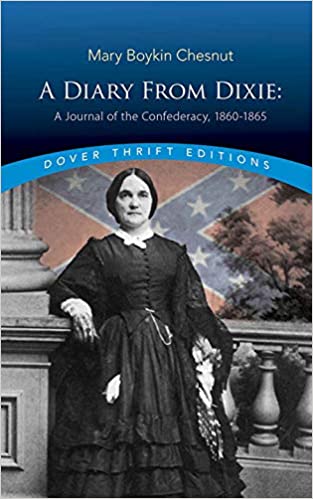
A Diary from Dixie: A Journal of the Confederacy, 1860-1865 by Mary Chesnut “Paperback of the book is released 12 Aug 2020”
Born into Southern aristocracy, Mary Boykin Chesnut (1823–86) married a rising star of the political scene who ultimately served as an aide to Confederate President Jefferson Davis. As a prominent hostess and popular guest in the highest circles of Confederate society, Chesnut possessed an insider's perspective on many of the Civil War's major events, which she recorded in vivid journal entries. Her diary recounts the social life that struggled to continue in the midst of war, the grim economic conditions that resulted from blockaded ports as well as how people's spirits rose and fell with each victory and defeat.
Hailed by William Styron as "a great epic drama of our greatest national tragedy," Chesnut's annotated diary won the Pulitzer Prize for History in 1982 and served as a primary source for Ken Burns's celebrated Civil War documentary. This edition of the compelling narrative features photos and engravings from the original publication.
J. E. B. STUART BOOKS
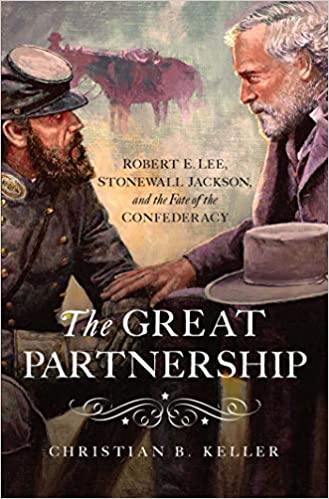
The Great Partnership: Robert E. Lee, Stonewall Jackson, and the Fate of the Confederacy by Christian Keller (Author) Hardcover pub, 2 Jul 2019
The story of the unique relationship between Lee and Jackson, two leaders who chiseled a strategic path forward against the odds and almost triumphed.
Why were Generals Lee and Jackson so successful in their partnership in trying to win the war for the South? What was it about their styles, friendship, even their faith, that cemented them together into a fighting machine that consistently won despite often overwhelming odds against them?
The Great Partnership has the power to change how we think about Confederate strategic decision-making and the value of personal relationships among senior leaders responsible for organizational survival. Those relationships in the Confederate high command were particularly critical for victory, especially the one that existed between the two great Army of Northern Virginia generals.
It has been over two decades since any author attempted a joint study of the two generals. At the very least, the book will inspire a very lively debate among the thousands of students of Civil War history. At best, it will significantly revise how we evaluate Confederate strategy during the height the war and our understanding of why, in the end, the South lost.
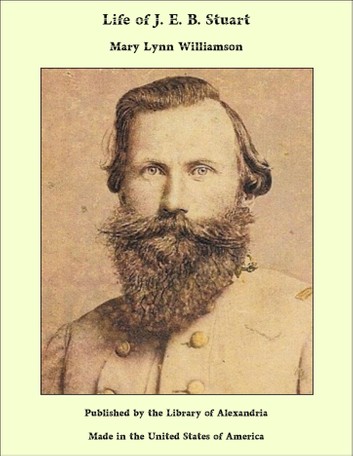
Life of J.E.B.Stuart by Mary Lynn Williamson New Release: Dec 2019
James Ewell Brown Stuart, commonly known as “Jeb” Stuart from the first three initials of his name, was born in Patrick county, Virginia, February 6, 1833. On each side of his family, he could point to a line of ancestors who had served their country well in war and peace and from whom he inherited his high ideals of duty, patriotism, and religion. He was of Scotch descent and his ancestors belonged to a clan of note in the history of Scotland. From Scotland a member of this clan went to Ireland.
About the year 1726, Jeb Stuart’s great-great-grandfather, Archibald Stuart, fled from Londonderry, Ireland, to the wilds of Pennsylvania, in order to escape religious persecution. Eleven years later, he removed from Pennsylvania to Augusta county, Virginia, where he became a large land-holder. At Tinkling Spring Church, the graves of the immigrant and his wife may still be seen.
Archibald Stuart’s second son, Alexander, joined the Continental army and fought with signal bravery during the whole of the War of the Revolution. After the war, he practiced law. He showed his interest in education by becoming one of the founders of Liberty Hall, at Lexington, Virginia, a school which afterwards became Washington College and has now grown into Washington and Lee University.
His youngest son who bore his name, was also a lawyer; he held positions of trust in his native State, Virginia, as well as in Illinois and Missouri where he held the responsible and honored position of a United States judge.
Our general’s father, Archibald Stuart, the son of Judge Stuart, after a brief military career in the War of 1812, became a successful lawyer. His wit and eloquence soon won him distinction, and his district sent him as representative to the Congress of the United States where he served four years.
There is an interesting story told about General Stuart’s mother’s grandfather, William Letcher. He had enraged the Loyalists, or Tories, on the North Carolina border, by a defeat that he and a little company of volunteers had inflicted on them in the War of the Revolution. One day in June, 1780, as Mrs. Letcher was alone at home with her baby girl, only six weeks old, a stranger, dressed as a hunter and carrying a gun in his hand, appeared at the door and asked for Letcher. While his wife was explaining that he would be at home in a short time, he entered and asked the man to be seated. (Pub: Dec 2019)
Ascent to Glory: the Genealogy of J.E. B. Stuart by Historian Thomas D. "Tom" Perry
Who presents a starting point for those interested in the genealogy of Civil War General James Ewell Brown "Jeb" Stuart in this revision of his first book. Concentrating on Stuart's siblings and his ancestors, this book gives those who may be related to Stuart a place to begin their search. (Pub: July 2008)
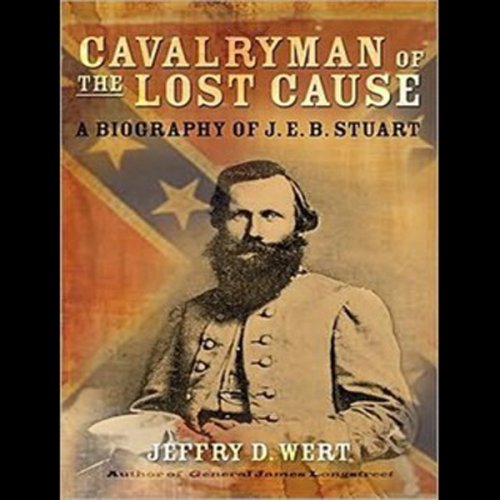
Cavalryman of the Lost Cause: A Biography of J.E.B. Stuart by Jeffry D. Wert(Pub: 2008)
Mortally wounded in battle when he was only 31, the dashing J. E. B. Stuart, the South's "plumed warrior knight", stands with Stonewall Jackson as one of the Confederacy's most revered martyrs. Union General John Sedgwick called him "the greatest cavalryman ever foaled in America". Jeffry D. Wert, however, offers a more balanced assessment in this comprehensive biography.
Wert's narrative portrait of Stuart - audacious and daring in battle, contentious with his staff and subordinates - is fast-paced and compelling, rich in telling details and human interest stories, yet objective, critical, and complete. Based on the most extensive research yet done utilizing governmental and archival sources, Wert's biography examines Stuart's controversial performance at Gettysburg and elsewhere.
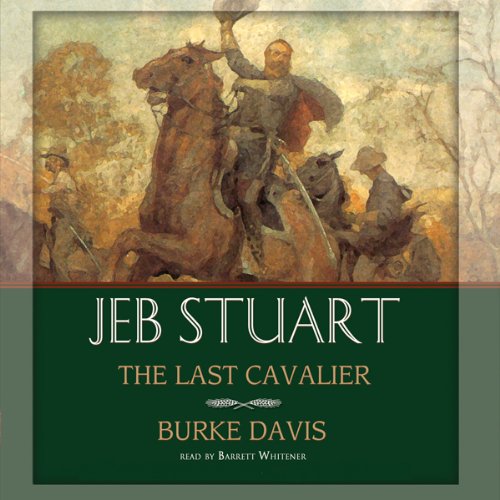
JEB Stuart, The Last Cavalier by Burke Davis (Pub 1957)
Here is a full and definitive biography of the dashing and enigmatic Confederate hero of the Civil War, General J.E.B. Stuart.
This life-size portrait of Stuart surveys his life from childhood through his training at West Point, his years on the Western frontier, and his decision to stand with Virginia when war arrived. His brilliant Civil War career is covered in detail, from the raid on Chambersburg through to his final, fatal clash at Yellow Tavern.
''The rudimentary field communications of the Civil War demanded of the cavalry the utmost in bravery, durability, and vigilance.'' writes Burke Davis in his introduction to this edition. ''Victory or defeat of armies was often in the hands of their cavalrymen.''